
March 15, 2026
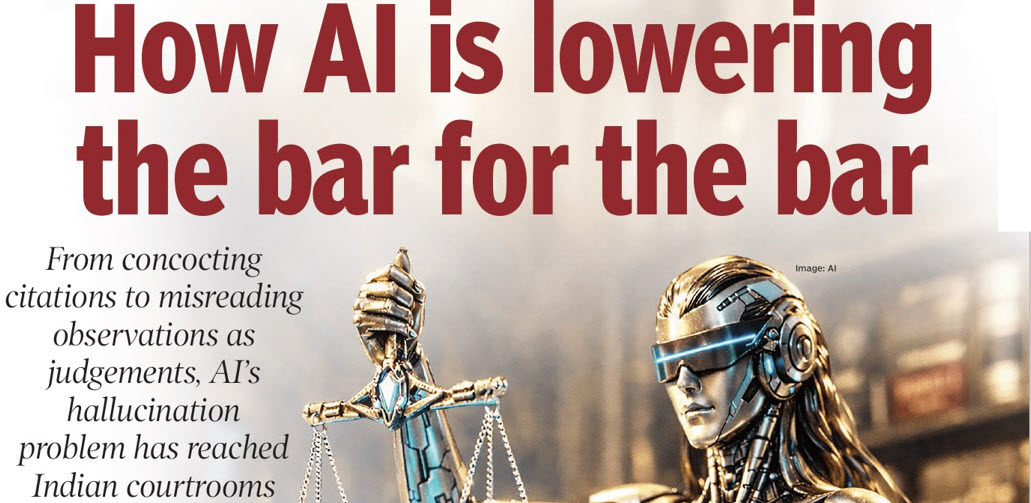 Today there is a detailed article in The Times of India highlighting the challenges posed by AI use in law. The article particularly highlights “AI’s hallucination”. Main problem is of fake citations. The problem is not in Indian courts only. They have been encountered in different parts of the world. The USA was perhaps the first country where a lawyer got into trouble because the material cited by him in court was found unreliable.
On September 29, 2025, the High Court of Delhi faced a similar problem making the following observations, “All learned senior counsel and counsel appearing for respondents submit that they would take appropriate steps since some of the judicial precedents cited on behalf of petitioner do not even exist and in some precedents, the quoted portions do not exist.”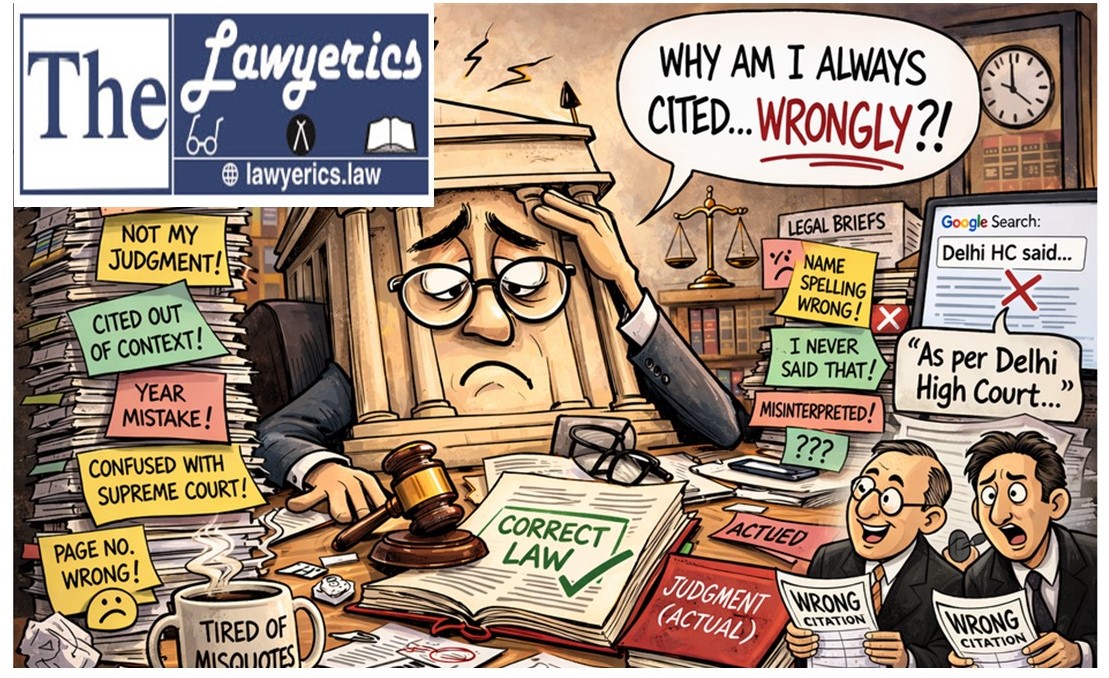 AI is a necessary evil. It is coming like a watershed. Its use in law cannot be avoided. We in TheLawyerics too are using it. Work pressure and rising costs force lawyers and law firms to use AI. However, the point is whether AI is used as tool or as an arbiter of a lawyer’s affairs. A lawyer using AI must decide for himself or herself whether AI is to be assigned assistive or generative role. We in TheLawyerics have used AI to process data of a large number of clients who wanted to pursue group litigation and found that in a short time, we could compile a large amount of data into a tabular information which put spotlight on the issue which needed court’s attention. Without AI, considerable manpower would have been required which would have escalated the cost.
Today there is a detailed article in The Times of India highlighting the challenges posed by AI use in law. The article particularly highlights “AI’s hallucination”. Main problem is of fake citations. The problem is not in Indian courts only. They have been encountered in different parts of the world. The USA was perhaps the first country where a lawyer got into trouble because the material cited by him in court was found unreliable.On September 29, 2025, the High Court of Delhi faced a similar problem making the following observations, “All learned senior counsel and counsel appearing for respondents submit that they would take appropriate steps since some of the judicial precedents cited on behalf of petitioner do not even exist and in some precedents, the quoted portions do not exist.”
AI use in law
Likewise, we tried some AI models to check our draft documents for inaccuracies. The results were quite satisfactory. AI pointed out useful corrections. For example, in one document we have been repeatedly using the year 2026, but at one place it was wrongly written as 2025. The AI pointed it out.
We in TheLawyerics have also tried AI for legal research. Sometimes it returns useful information and sometimes not. One always needs to be on the guard when reputed AI brands are used. The law reports which are in Indian market are struggling to infuse AI in their database so that legal research is made still better. Let us see when they come out with a law-specific AI model which specifically caters to the needs of judicial system.
The main problem is that most of the reputed AI models in the market invite you to take their help in drafting legal documents, or to summarise the documents, like the judgments. This is where the AI is not yet perfect and creates a problem. For the sake of fun, we invite you to ask some popular AI model to draft a live-in relationship agreement for you. And see carefully whether you get some clauses which appear to be of rent agreement!
Our general experience is that a lawyer should not subject his or her professional wisdom to AI’s wisdom. AI’s role should never be taken as decisive.
The way the judicial administration in India is debilitating due to delays, makes it imperative that AI is pressed into service but for the time being, a credible AI model is not yet available. It is for the Supreme Court to assume leadership for this. If the Supreme Court is taking several Public Interest Litigations (PILs), some of which are unnecessary, it should divert its attention to the issue on which it ought to.

We in TheLawyerics have also tried AI for legal research. Sometimes it returns useful information and sometimes not. One always needs to be on the guard when reputed AI brands are used. The law reports which are in Indian market are struggling to infuse AI in their database so that legal research is made still better. Let us see when they come out with a law-specific AI model which specifically caters to the needs of judicial system.
The main problem is that most of the reputed AI models in the market invite you to take their help in drafting legal documents, or to summarise the documents, like the judgments. This is where the AI is not yet perfect and creates a problem. For the sake of fun, we invite you to ask some popular AI model to draft a live-in relationship agreement for you. And see carefully whether you get some clauses which appear to be of rent agreement!
Our general experience is that a lawyer should not subject his or her professional wisdom to AI’s wisdom. AI’s role should never be taken as decisive.
The way the judicial administration in India is debilitating due to delays, makes it imperative that AI is pressed into service but for the time being, a credible AI model is not yet available. It is for the Supreme Court to assume leadership for this. If the Supreme Court is taking several Public Interest Litigations (PILs), some of which are unnecessary, it should divert its attention to the issue on which it ought to.
TheLawyerics
Click the link below to download PDF
AI in law
AI in law