 The High Court of Delhi (through its Vacation Judge) upheld the temporary ban on messaging App, Telegram, so that the paper leakage that occurred in NEET-2026 does not happen again in the re-NEET on June 21, 2026 (https://lawyerics.ai/wp-content/uploads/2026/06/2026-06-19-DelHC-TelegramBan.pdf). Telegram is not responsible for the leakage, but it facilitated the spread of leakage to every part of the country. 2026-06-19-DelHC-TelegramBan
A review of the architecture and working of the App revealed that it was a self-generating monster. If one group in the App was blocked, it could regroup itself in another form. The facilities provided to the users in terms of storage and number of targeted recipients of the message were also much higher than those of sister apps such as WhatsApp. The App’s operations are cloud-based, which makes it more difficult to detect illegal activity, if any, through personal devices of suspect persons. Apparently, the App anticipated that Governments all over the world, at some point, might try to control its activities and the activities of its users and, in order to outsmart the Governments, it created some features which could overcome governmental measures.
Dissemination of leaked paper through Telegram was a big embarrassment for the Indian Government, and it took the strongest possible measures to prevent leakage in re-NEET. The blanket ban order issued by the Government confirms the saying, ‘once bitten, twice shy.’
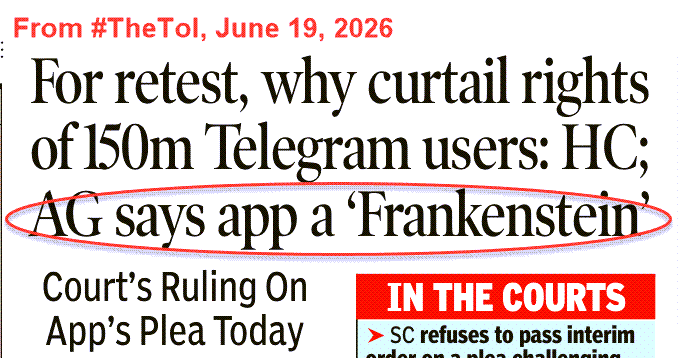
Two objections were raised before the High Court of Delhi: (i) there was no justification for totally banning the App up to June 22, 2026, and (ii) disabling the editing feature in the App up to June 30. Telegram’s plea was that the restrictions, total or partial, were unconstitutional inasmuch as they were arbitrary, unfair and disproportionate. Government lawyers, on the other hand, described the App as a “Frankenstein” to justify such a strong measure against it.
Telegram App
There is not much discussion of law in the Judgment because the High Court did not get adequate time to go into niceties of law when it had to decide the matter overnight. Besides, it was also necessary to send a strong message to assure the NEET-aspirants that this time, integrity of the examination process will be preserved by all means. The judgment has facilitated the Governmental measures to this end. However, long-term effects of the judgment need to be properly considered.
Telegram’s monstrous practices are not something which suddenly cropped up only at the time of paper leakage. Those who prefer safe messaging generally avoid Telegram. This was known to the Government and to the general public for quite some time. The question is what the Government was doing when disruptive potential of the App was already known to the Government. Intelligence agencies in India are quite capable of assessing disruptive potentialities of various social media platforms, yet they waited for the worst to happen. This is the peculiar feature of Indian authorities. They act post-facto, rather than taking preventive measures based on anticipated risks. Courts in India too are a part of this kind of approach. They do not question the administrative authorities as to why requisite measures were not taken in good times.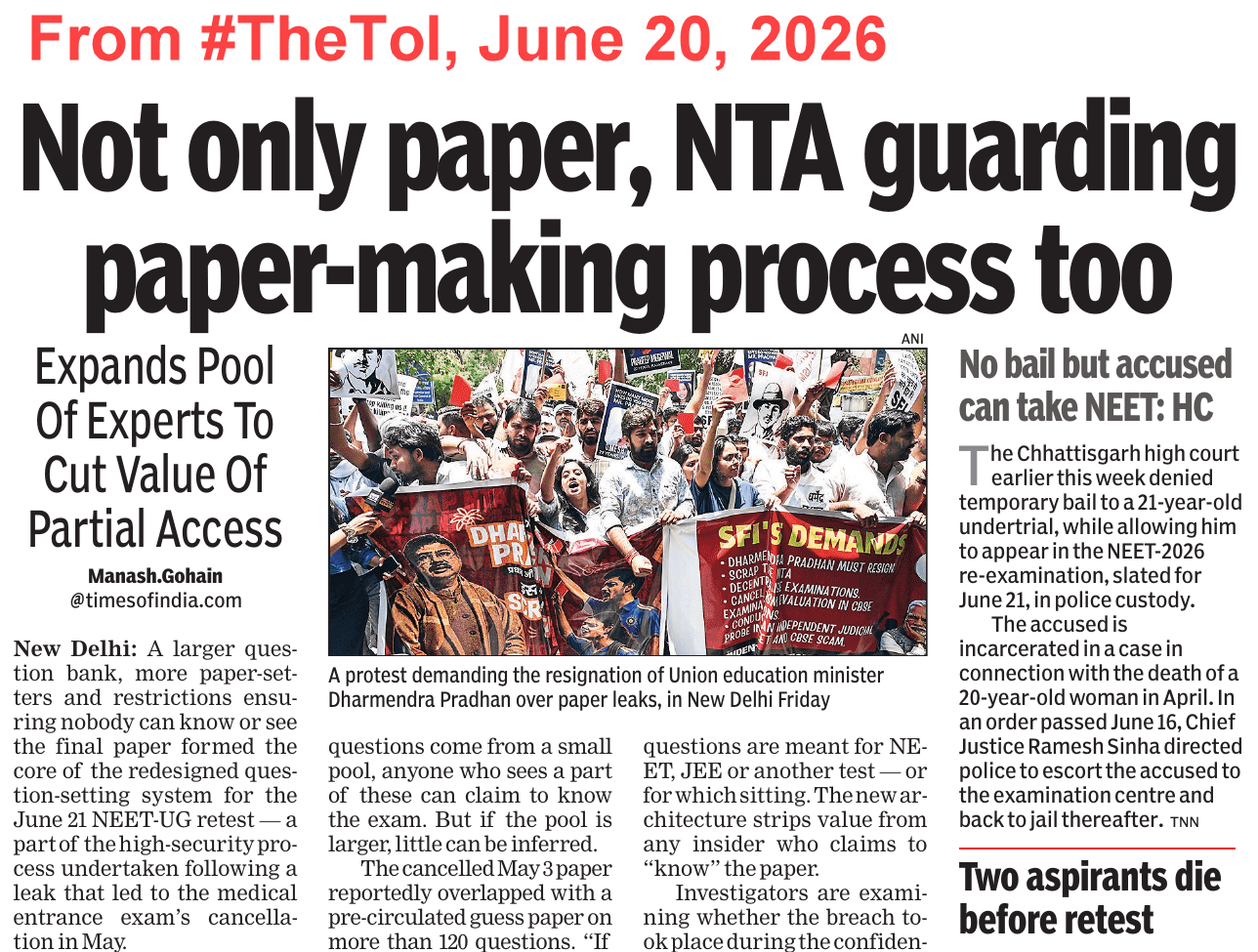
The High Court has held that the complete ban satisfies the test of proportionality, but it is doubtful that it is really so. Proportionality requires that administrative authorities take a measured response. The NEET retest will be over at 5.15 PM on June 21, but if we go by the official order, the time-limit set for blocking of the App is “till 22nd June 2026” and the time-limit for disabling of its editing facility is “till 30th June 2026”. The App will accordingly remain blocked up to 12 midnight of June 22. Why, when the examination will be over on June 21 at 5.15 PM? There may be some reason for stretching the ban beyond the time of the examination but there is no discussion on it in the High Court judgment. There is some justification for disabling the editing feature of the App till June 30 to catch hold of the culprits if at all there is leakage again, but one does not understand what is there to be leaked when the examination is over at 5.15 PM on June 21.
Frankly, we at TheLawyerics also feel that Telegram App cannot be put to use if one is concerned about his/her privacy and security. Comparative use of WhatsApp and Telegram is somewhat like this – whether one would like to dine at a family restaurant or at a bar. However, there are a substantial number of citizens who have chosen to use Telegram. Perhaps their views about privacy and security are not the same as ours. They may be finding the App quite useful for their purpose. We do not have any right or power to impose our views on others. It is often said that I can stretch my hand up to the distance that it does not touch the nose of another person. If I do it, the other person will push my hand back, and while doing it, he may twist my hand in a way that I start screaming. Different users may have different views about Telegram. The wholesale ban till June 22 is beyond comprehension unless the High Court had found some justification for it after making an enquiry with the Government.
The decision rendered in the Telegram case was made in haste, understandably to address the concerns of young aspirants and their parents. Everyone has sympathy for them. It is because of this no individual has raised an objection against the blanket ban. However, the High Court judgment in the Telegram case requires reconsideration as and when the next similar case arises. Consistent with the principle of proportionality, the courts ought to demand strict proof from the authorities about the duration of the ban order.
Social Media – Ban – Legal Implications