Digital Assets – A Case for their heritability
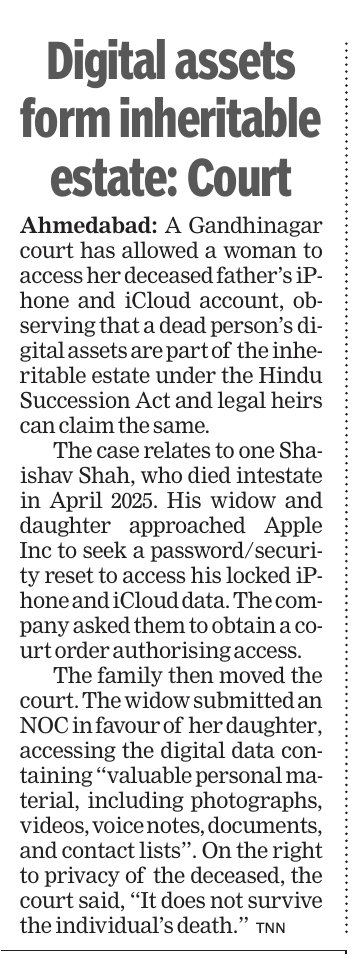
We in TheLawyerics tried to get a copy of the order/Judgment by visiting the official portal of Gandhi Nagar district courts but it was of no avail. The case details could not be traced on the portal. Besides, most of the orders/judgments so far uploaded on the portal are in Gujarati. It was another problem. I could make out something from Gujarati based on my knowledge of Hindi, but it was not an easy exercise. Even the case details do not appear to be available on the district court’s portal. I then pressed into service ChatGPT, but ChatGPT repeatedly referred back to The Times of India clipping which provides only name of the party and the counsel. Practically, the search reached a dead end.
All that the newspaper reveals is that the legal heirs of the deceased who was a registered user of Apple cloud service wanted to access the deceased’s Apple account, but Apple asked the legal heir to obtain a court order. The legal heir who appeared to be the daughter of the deceased, with the consent of her mother, was successful in obtaining an order from district court based on the succession law and property law in India. However, it appears that limited relief which the claimant seems to have got from the court is that Apple as a service provider ought to provide access to deceased’s account by revealing user Id and password so that legal heir could retrieve deceased’s digital material placed on Apple’s cloud service.
However, that is not all for most of those like me who have spent considerable time and labour in building a profile on social media. Take my example. Generating posts for social media is not an easy job. Each post involves labour of several hours, and over and above,
it is the outcome of knowledge and experience gained over several decades. Irrespective of the slippery definitions of property and goodwill, we in TheLawyerics feel that the contents generated by me are our property. They have been crafted after putting in considerable skill, time and labour. Not only me, even the next generation to which I shall pass on assets in whatever forms they are, should be able to take their advantage and should take my initiative forward, by building on whatever I leave. The nature works on law of propagation and perpetuity. The entire edifice of succession law is built on one basic principle that a person should be allowed to pass on his or her belongings, in whatever form they are, to living persons who in most of cases are his or her own descendants. Even intellectual property rights, which are intangible rights, are heritable. Social media contents, and the reputation and the goodwill created through them, should be protected the same way other proprietary rights are protected.
Keeping in view that social media accounts and the contents put in public domain through them, now are based on one’s skills and labour, there is need for a proper legal framework for its transferability and succession. For the time being, our relationships with social media platforms and other service providers, including even e-mail service providers are contractual. They define the terms and conditions subject to which we can avail of their services. A user has practically no choice. Element of negotiation or bargaining is practically missing. A user cannot customise the terms of service. Added to this, we in India, have become so habitual to free service, that we readily tick the check box without even reading what is written there. And take it from me, the terms of service are heavily loaded in favour of service provider. The service provider can block our account. For the time being, we are in the hands of the service providers whether they allow or deny access to the next generation whom I would like to pass on my intangible assets. It would be ideal if some statutory provision is made for nomination for transfer of digital assets. The point is that if I create digital assets over a period of time by dint of my hard work, even the social media platforms should not be able to deprive me of their benefits without the authority of law. There ought to be legal recognition for my right to dispose of them, the way I like.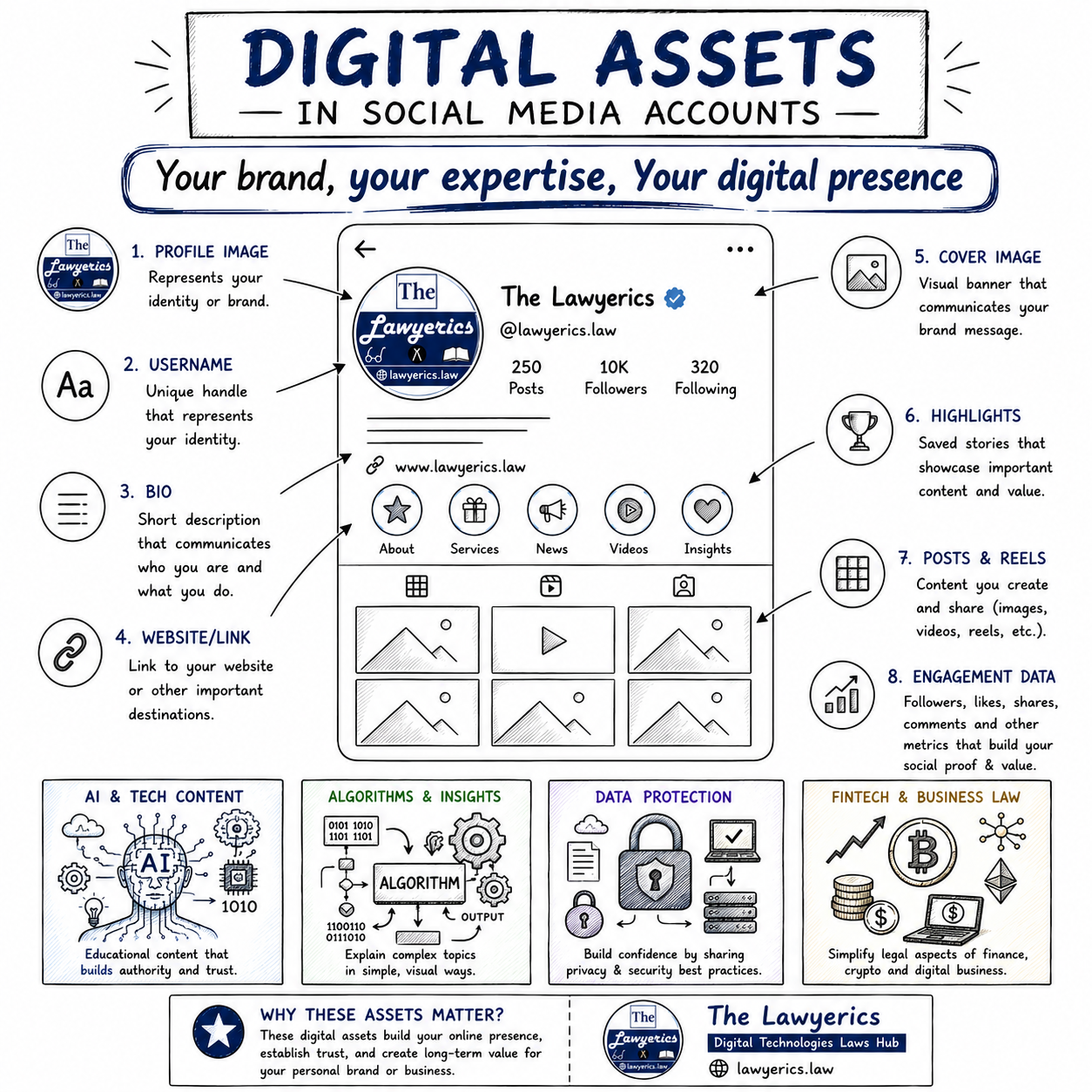
Keeping in view that social media accounts and the contents put in public domain through them, now are based on one’s skills and labour, there is need for a proper legal framework for its transferability and succession. For the time being, our relationships with social media platforms and other service providers, including even e-mail service providers are contractual. They define the terms and conditions subject to which we can avail of their services. A user has practically no choice. Element of negotiation or bargaining is practically missing. A user cannot customise the terms of service. Added to this, we in India, have become so habitual to free service, that we readily tick the check box without even reading what is written there. And take it from me, the terms of service are heavily loaded in favour of service provider. The service provider can block our account. For the time being, we are in the hands of the service providers whether they allow or deny access to the next generation whom I would like to pass on my intangible assets. It would be ideal if some statutory provision is made for nomination for transfer of digital assets. The point is that if I create digital assets over a period of time by dint of my hard work, even the social media platforms should not be able to deprive me of their benefits without the authority of law. There ought to be legal recognition for my right to dispose of them, the way I like.
Digital media – heritability
Click the link below to download PDF
Digital Assets – A Case For Their Heritability
Digital Assets – A Case For Their Heritability