
Court notices – Electronic delivery – Pros and cons
February 19, 2026
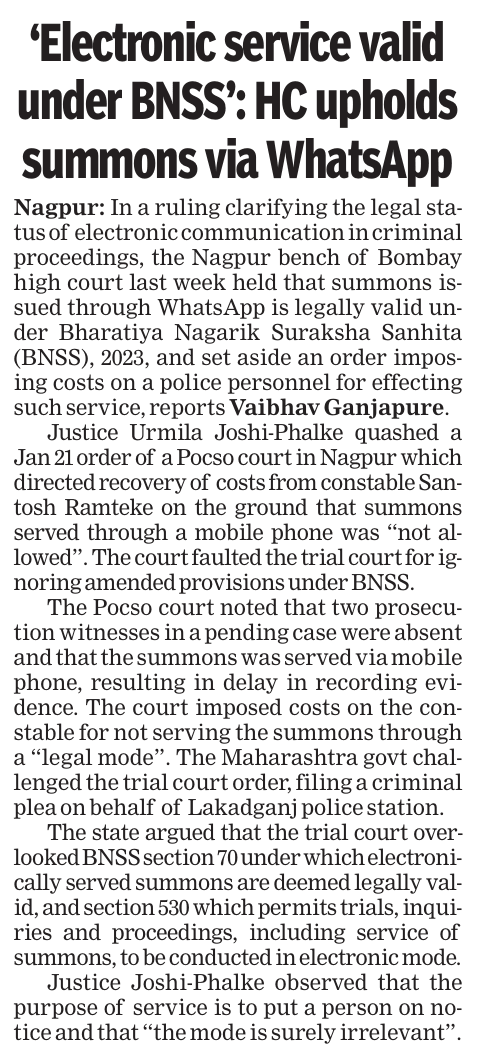
The above news item in the Times of India prompted me to study the Judgement in detail, though with some surprise and suspicion about its soundness. The link for the judgment is being shared so that you may also read it if you so desire.
https://lawyerics.ai/wp-content/uploads/2026/02/HighCourtOrder.pdf
The Bombay High Court (Nagpur Bench) referred to Sections 64 to 71 of BNSS, 2023, and then specifically quoted Section 70(3) which permits electronic service but then there is a rider also that “a copy of such summons shall be attested and kept as a proof of service of summons.”
There is parallel provision in Rule 9 of Order V of the Civil Procedure Code, 1908 which deals with “Delivery of summons by Court.” There is no specific mention about electronic delivery apparently because the Code was framed much earlier, contrary to today’s situation when modes of communication through digital and electronic-magnetic technologies have taken the world by storm.
However, there is a general provision in Section 4 of the Information Technology Act, 2000, giving legal recognition to electronic records. The provision reads as follows, “Where any law provides that information or any other matter shall be in writing or in typewritten or printed form, … such requirement shall be deemed to have been satisfied if such information or matter is – (a) rendered or made available in an electronic form; and (b) accessible so as to be useable for a subsequent reference.”
In other words, the e-governance, and for that matter, e-courts system is leaning in favour of electronic modes of delivery. This is desirable also because there is no necessity to send a process server and then wait for his report when we have advanced so much in technology. However, electronic delivery cannot be adopted without proper safeguards. We know the instances of digital arrests. Investigating agencies and even courts are being faked. As if it were not sufficient, deep fakes are also being used by criminals.
Court notices – WhartsApp service
The above news item in the Times of India prompted me to study the Judgement in detail, though with some surprise and suspicion about its soundness. The link for the judgment is being shared so that you may also read it if you so desire.
https://lawyerics.ai/wp-content/uploads/2026/02/HighCourtOrder.pdf
The Bombay High Court (Nagpur Bench) referred to Sections 64 to 71 of BNSS, 2023, and then specifically quoted Section 70(3) which permits electronic service but then there is a rider also that “a copy of such summons shall be attested and kept as a proof of service of summons.”
There is parallel provision in Rule 9 of Order V of the Civil Procedure Code, 1908 which deals with “Delivery of summons by Court.” There is no specific mention about electronic delivery apparently because the Code was framed much earlier, contrary to today’s situation when modes of communication through digital and electronic-magnetic technologies have taken the world by storm.
However, there is a general provision in Section 4 of the Information Technology Act, 2000, giving legal recognition to electronic records. The provision reads as follows, “Where any law provides that information or any other matter shall be in writing or in typewritten or printed form, … such requirement shall be deemed to have been satisfied if such information or matter is – (a) rendered or made available in an electronic form; and (b) accessible so as to be useable for a subsequent reference.”
In other words, the e-governance, and for that matter, e-courts system is leaning in favour of electronic modes of delivery. This is desirable also because there is no necessity to send a process server and then wait for his report when we have advanced so much in technology. However, electronic delivery cannot be adopted without proper safeguards. We know the instances of digital arrests. Investigating agencies and even courts are being faked. As if it were not sufficient, deep fakes are also being used by criminals.
Court notice – WhatsApp
Normally it is said about WhatsApp that if double blue tick appears on sender’s device, it is an indication that message has not only been delivered but it has also been seen by the recipient. But at the same time, the recipient has option to disable this feature if he wants to have more privacy. Several people are doing it. If the recipient has disabled this feature, there is no credible means to assert that WhatsApp message stands delivered.
We in TheLawyerics encountered the above problem and found an alternative that there is a private service-provider, RPost, which certifies delivery of e-mail and opening of mailbox by the recipient. The service provider gives precise time when the mail was delivered to the recipient’s server and he opened his mailbox. The Supreme Court’s reference to RPost in Fugro Survey v. Rumania International, (2012) 10 SCC 754, gives an endorsement to this service.
However, this gives rise to another legal problem whether it is permissible to the service provider to intrude into recipient’s server and mailbox to pull out information relating to recipient’s activities. It is just like courier entering into my house and finding out whether I have opened the packet delivered to me. There is perhaps no caselaw on the issue like this. However, the fact remains that this kind of service for the time being has Supreme Court’s implied endorsement. Moreover, RPost is a patented technology in USA which too gives it a limited official recognition.
We in TheLawyerics encountered the above problem and found an alternative that there is a private service-provider, RPost, which certifies delivery of e-mail and opening of mailbox by the recipient. The service provider gives precise time when the mail was delivered to the recipient’s server and he opened his mailbox. The Supreme Court’s reference to RPost in Fugro Survey v. Rumania International, (2012) 10 SCC 754, gives an endorsement to this service.
However, this gives rise to another legal problem whether it is permissible to the service provider to intrude into recipient’s server and mailbox to pull out information relating to recipient’s activities. It is just like courier entering into my house and finding out whether I have opened the packet delivered to me. There is perhaps no caselaw on the issue like this. However, the fact remains that this kind of service for the time being has Supreme Court’s implied endorsement. Moreover, RPost is a patented technology in USA which too gives it a limited official recognition.
There is one more aspect. We tested RPost’s service but found that they provide certificate of delivery without making commitment that if their testimony is required in court, they will come forward. In such situation, the litigant has to do self-service by falling back on Sections 61 to 63 of the BSA, 2023 i.e., proof of electronic evidence.
All these aspects need deeper consideration. But tentatively our view is that WhatsApp and other free services cannot be readily accepted as credible proof of delivery. As far as our knowledge goes, the police officials use their personal electronic devices, perhaps because they are not provided with official mobile numbers. It is suggested that electronic delivery of court notices, in order to be acceptable in law, should be through accredited service-providers. If this is ensured, electronic delivery will be more time effective and cost effective. The accredited service can be armed legal authority to pull out information from recipient’s server and mailbox. That is enough for the court to proceed with case before it.
Coming back to Bombay High Court judgment, its ruling is based on its peculiar facts. The trial court was somewhat unhappy with the police official who sent court notice through WhatsApp but did not care to produce a paper copy of delivery so that court was satisfied that service was complete. But every case is not like this case. Most of the parties affecting by hand delivery, file proof of service or affidavit of service in the court.
There is scope for further discussion on electronic delivery of court notices irrespective of ruling of Bombay High Court.

We in TheLawyerics encountered the above problem and found an alternative that there is a private service-provider, RPost, which certifies delivery of e-mail and opening of mailbox by the recipient. The service provider gives precise time when the mail was delivered to the recipient’s server and he opened his mailbox. The Supreme Court’s reference to RPost in Fugro Survey v. Rumania International, (2012) 10 SCC 754, gives an endorsement to this service.
However, this gives rise to another legal problem whether it is permissible to the service provider to intrude into recipient’s server and mailbox to pull out information relating to recipient’s activities. It is just like courier entering into my house and finding out whether I have opened the packet delivered to me. There is perhaps no caselaw on the issue like this. However, the fact remains that this kind of service for the time being has Supreme Court’s implied endorsement. Moreover, RPost is a patented technology in USA which too gives it a limited official recognition.
We in TheLawyerics encountered the above problem and found an alternative that there is a private service-provider, RPost, which certifies delivery of e-mail and opening of mailbox by the recipient. The service provider gives precise time when the mail was delivered to the recipient’s server and he opened his mailbox. The Supreme Court’s reference to RPost in Fugro Survey v. Rumania International, (2012) 10 SCC 754, gives an endorsement to this service.
However, this gives rise to another legal problem whether it is permissible to the service provider to intrude into recipient’s server and mailbox to pull out information relating to recipient’s activities. It is just like courier entering into my house and finding out whether I have opened the packet delivered to me. There is perhaps no caselaw on the issue like this. However, the fact remains that this kind of service for the time being has Supreme Court’s implied endorsement. Moreover, RPost is a patented technology in USA which too gives it a limited official recognition.
There is one more aspect. We tested RPost’s service but found that they provide certificate of delivery without making commitment that if their testimony is required in court, they will come forward. In such situation, the litigant has to do self-service by falling back on Sections 61 to 63 of the BSA, 2023 i.e., proof of electronic evidence.
All these aspects need deeper consideration. But tentatively our view is that WhatsApp and other free services cannot be readily accepted as credible proof of delivery. As far as our knowledge goes, the police officials use their personal electronic devices, perhaps because they are not provided with official mobile numbers. It is suggested that electronic delivery of court notices, in order to be acceptable in law, should be through accredited service-providers. If this is ensured, electronic delivery will be more time effective and cost effective. The accredited service can be armed legal authority to pull out information from recipient’s server and mailbox. That is enough for the court to proceed with case before it.
Coming back to Bombay High Court judgment, its ruling is based on its peculiar facts. The trial court was somewhat unhappy with the police official who sent court notice through WhatsApp but did not care to produce a paper copy of delivery so that court was satisfied that service was complete. But every case is not like this case. Most of the parties affecting by hand delivery, file proof of service or affidavit of service in the court.
There is scope for further discussion on electronic delivery of court notices irrespective of ruling of Bombay High Court.
TheLawyerics
Click the link below to download PDF
CourtNotices-ElectronicDelivery
CourtNotices-ElectronicDelivery