(Need of the hour is to take urgent steps for welfare oriented legislation before it becomes too late)
AI Regulation
Mr. IT Minister, how long will you keep resorting to patchy solutions? Digital technologies as a whole are disruptive in nature for the time being. They are changing old ways and values of the society. As I have often said, they have shrinked time and space to nearly zero. They are being used and misused.
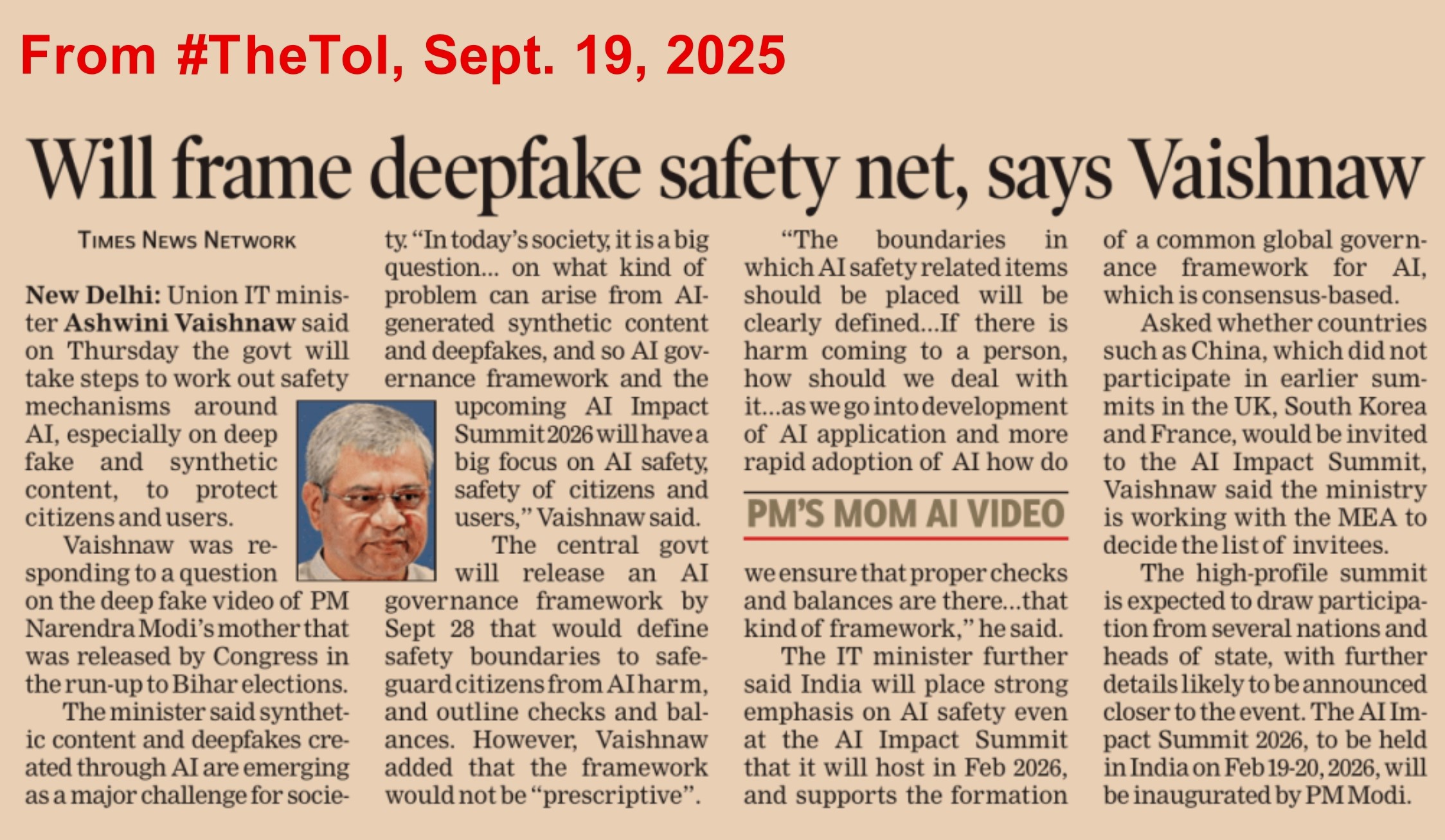
Today it is the Prime Minister Modi’s deceased mother who has been deep-faked, tomorrow it may be Prime Minister himself deep-faked as engaging in playful acts with a woman of loose character. You have to tackle the problem from its roots. The problem starts with the basic characteristics of digital technologies, and the solutions lies in regulating them.
The digital technologies started with a simple machine which worked as calculator. Somehow the world understood working of semiconductors of storing the electric charge, or current and no current, and used it as ‘0’ and ‘1’, and then created codes of 0s and 1s by permutation and combination, and then into information comprehendible by human beings. The entire system is based on the principle of physics that a semiconductor can act with a lightning speed and can perform repetitive functions with a speed which is impossible for human mind. This initially enabled the computers of olden days to process data which they could convert into useful information. That is why it is called digital technology.
Parallelly, the technology of networking was developed which enabled two or more computers to share information amongst themselves. Then came internet which has connected the entire world. The technology got further boost from principle of electro-magnetism and transmission of signals through optical fibre. Electromagnetic waves do not need any medium (like air) to travel. They can travel in vacuum also. Optical fibres have exploited the principle of total internal reflection – a ray of light can be bent in “V” shape within an optical fibre and can travel a distance of thousands and thousands miles.
Then came on the scene the information aggregators like Google which stored a huge amount of information with them. Then came
From the data giants, Artificial Intelligence (AI) emerged, which essentially identifies patterns from a large amount of information and then tries to convert patterns into abstract form of inform which we call as AI.
My reading of literature on AI does not make me optimistic. I find that some sort of narratives are being set by the promoters of AI that a utopia is in the making. In short term, AI is holding some promises but in the long run, it is destroying humanity. Without naming a book which I am reading these days, I would like to share with you what it is predicting. It says that AI will surpass human intelligence and will take human beings to new horizons. Well, this does not convince me.
Human consciousness is a composite of our senses, mind, intelligence and above all our instinct to be happy and at peace. Instinctually, we are in search of peace which is everlasting. Our consciousness is not necessarily logic. It is something which satisfies our inner urge, and we want such urge to be everlasting. This is what is eluding us. Our whole pursuit is to search for something that is everlasting. For the time being, some sort of convenience we are getting is being understood as great promises of so-called AI. It is for this reason I say, AI cannot be a perfect substitute of natural intelligence.
History supports my view. Dynamite was created for mining purpose but it was used for destroying human beings. Nuclear reaction was discovered for producing energy but atom bomb emerged from it. So is the case with AI in particular and digital technologies in general. Governments all over the world are found napping. They have some idea about potential effects of AI and other digital technologies but the kind of preparation needed to regulate it is lacking for the time being. The result, as I can visualize, is that world order in which these digital technologies are evolving at present, might destroy that world order itself.
Coming back to deep fakes, law of copyright permits parody or mimicry if it is in a decent way because it is considered as a source of collective entertainment and social cohesion. But deep fake as is being presently used, can do any harm. It can spread harmful information beyond imagination. Anything can happen. I guess, the governments all over the world, including India are waiting something worse to happen before they wake up.
Digital technologies have to be caught by their horns if they are to be used for benefit of humanity. A comprehensive legislation is urgently needed. There are three basic characteristics of digital technologies, (i) enormous processing speed, (ii) enormous storage capacity, and (iii) enormous speed of transmission. Now their interaction with human beings and their impact on human beings has become irreversible. We need to be concerned that they do not make our condition worse. Hence the need for comprehensive legislation. Deep fake is only one aspect of it.
Digital Technologies – Comprehensive Legislation