
Should India Protect USA’s I.P. interests also?
IPRs
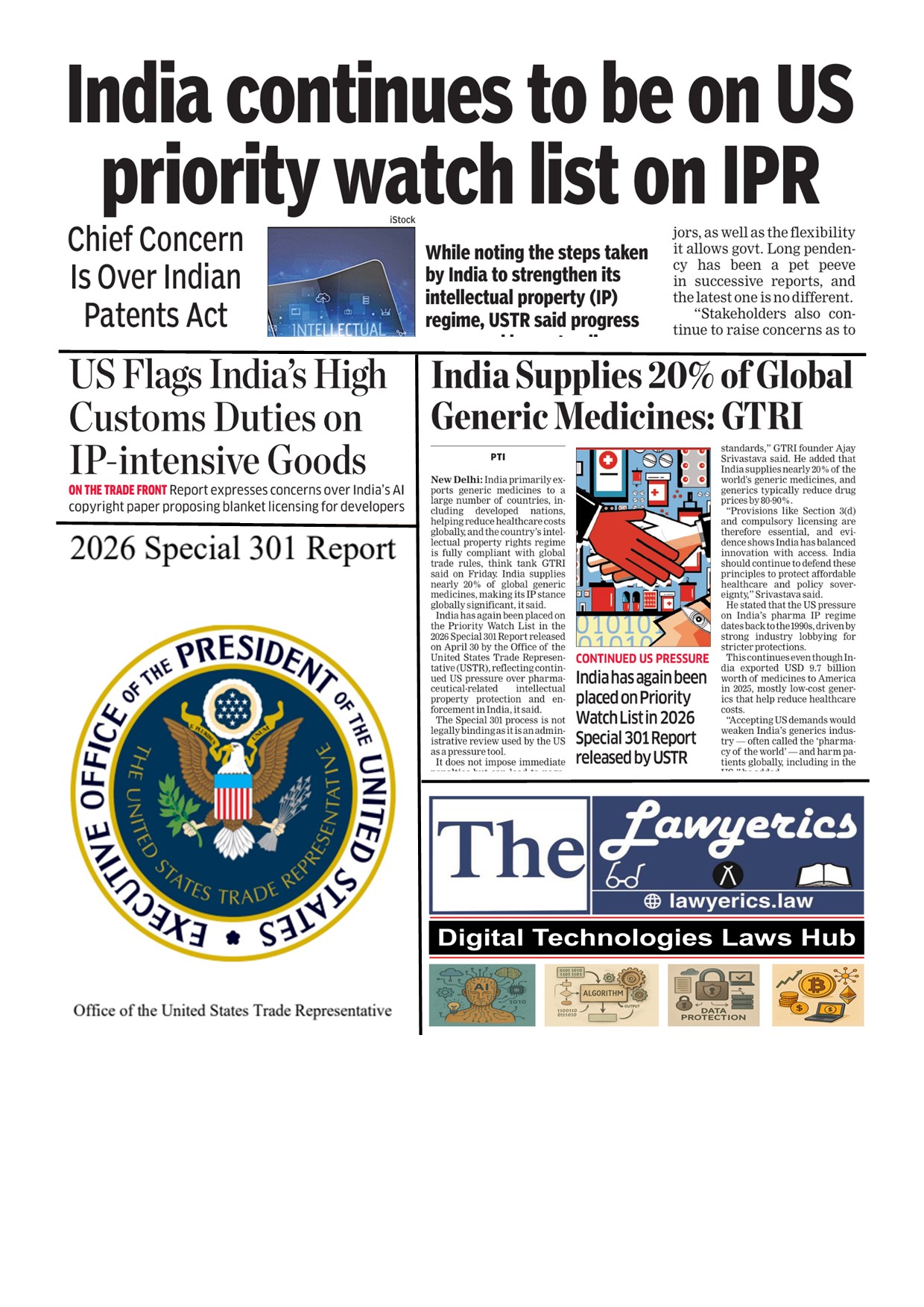
While scrolling today’s newspapers, I found that both The Times of India and The Economic Times have covered “2026 Special 301 Report of the United States Trade Representative”, adversely commenting on intellectual property regime in India. The press clippings are reproduced above. The links for accessing the full length of these clippings and the 301 Report are also shared with you so that you may read the full text. The question being discussed here is whether it is necessary for India to go by criticism of US authority about Indian affairs.
After the TRIPS Agreement in 1994, India carried out extensive changes in 2003 to amend the Patents Act, 1970, apparently to fulfil its TRIPS obligations. However, it cleverly protected its status as pharmacy of the world. India is one of biggest suppliers of generic drugs to the world, and through the jugglery of definitions in patent law, India managed to protect its pharmaceutical industry manufacturing generic drugs, to make sure that patent regime does not become hypersensitive. This is one of the sore points between India and US.
The other thing which India did was not allow software applications to be patented. Only copyright could be claimed. Apparently, the protection is limited to idea-expression dichotomy in copyright law. This is also not good from US point of view.
The question is why these conflicts arise. Intellectual property laws these days are not based on morals.
They are driven by industrial needs of a country. Even the World Trade Organization (WTO) and the TRIPS Agreement are the outcome of efforts of technologically advanced countries to protect their intellectual property rights, and at the same time, to extend its trading activities globally. Everyone familiar with the patent law, knows the liberal approach of the US courts to protect patents of that country. One typical example is decision of US Supreme Court in Diamond v. Chaktrabarty, 447 US 303 (1980). The Chief Justice, Burger, while referring to patent legislation, noted, “The Committee Reports accompanying the 1952 Act inform us that Congress intended statutory subject matter to include anything under the sun that is made by man.” It was so held because in 20th century, USA was most technologically advanced country, and its innovators needed protection. On the other hand, countries like India, needed technology for its development and that too at affordable costs. This is how India navigated its patent regime through the Indian Patents and Designs Act, 1911 and now the Patents Act, 1970.
However, there are instances where Indian courts too have missed opportunity to strike a fair balance between innovation and affordability of pharmaceutical products. The glaring instance which comes to our mind is the Supreme Court decision in Novartis AG v. Union of India, (2013) 6 SCC 1. It was a tug of war between internationally reputed drug manufacturing company, Novartis, and our Indian generic manufacturer, Natco Pharma over medicine developed by Novartis for cancer treatment. As usual, Novartis’ infringement action against NATCO was greeted with invalidity of Novartis patent. The Supreme Court through its legal craftsmanship denied patent protection to Novartis. We in TheLawyerics feel that the Supreme Court should have devised some via media. The patent ought to have been protected and the Central Government had been directed to invoke its extraordinary power under the Act to make available patented drug at affordable price in India. Innovation ought not have been discouraged by invalidating the patent itself. It was open to the Supreme Court to invoke its Article 142 power also.
In any case the situation is that every stakeholder, whether the innovator or the user tried to pull the situation in its favour by interpreting patent law in its own. But certainly, the US cannot be the international policeman to tell India what it should do or not to do to protect intellectual property. Our respect for innovation from all direction of the world in India should come from within.
However, there are instances where Indian courts too have missed opportunity to strike a fair balance between innovation and affordability of pharmaceutical products. The glaring instance which comes to our mind is the Supreme Court decision in Novartis AG v. Union of India, (2013) 6 SCC 1. It was a tug of war between internationally reputed drug manufacturing company, Novartis, and our Indian generic manufacturer, Natco Pharma over medicine developed by Novartis for cancer treatment. As usual, Novartis’ infringement action against NATCO was greeted with invalidity of Novartis patent. The Supreme Court through its legal craftsmanship denied patent protection to Novartis. We in TheLawyerics feel that the Supreme Court should have devised some via media. The patent ought to have been protected and the Central Government had been directed to invoke its extraordinary power under the Act to make available patented drug at affordable price in India. Innovation ought not have been discouraged by invalidating the patent itself. It was open to the Supreme Court to invoke its Article 142 power also.
In any case the situation is that every stakeholder, whether the innovator or the user tried to pull the situation in its favour by interpreting patent law in its own. But certainly, the US cannot be the international policeman to tell India what it should do or not to do to protect intellectual property. Our respect for innovation from all direction of the world in India should come from within.
Click here to download PDF
IPRs in India – USA Perspective
IPRs in India – USA Perspective