
SHANTI ACT
(nuclear entrepreneurship era)
(nuclear entrepreneurship era)
January 20, 2025:
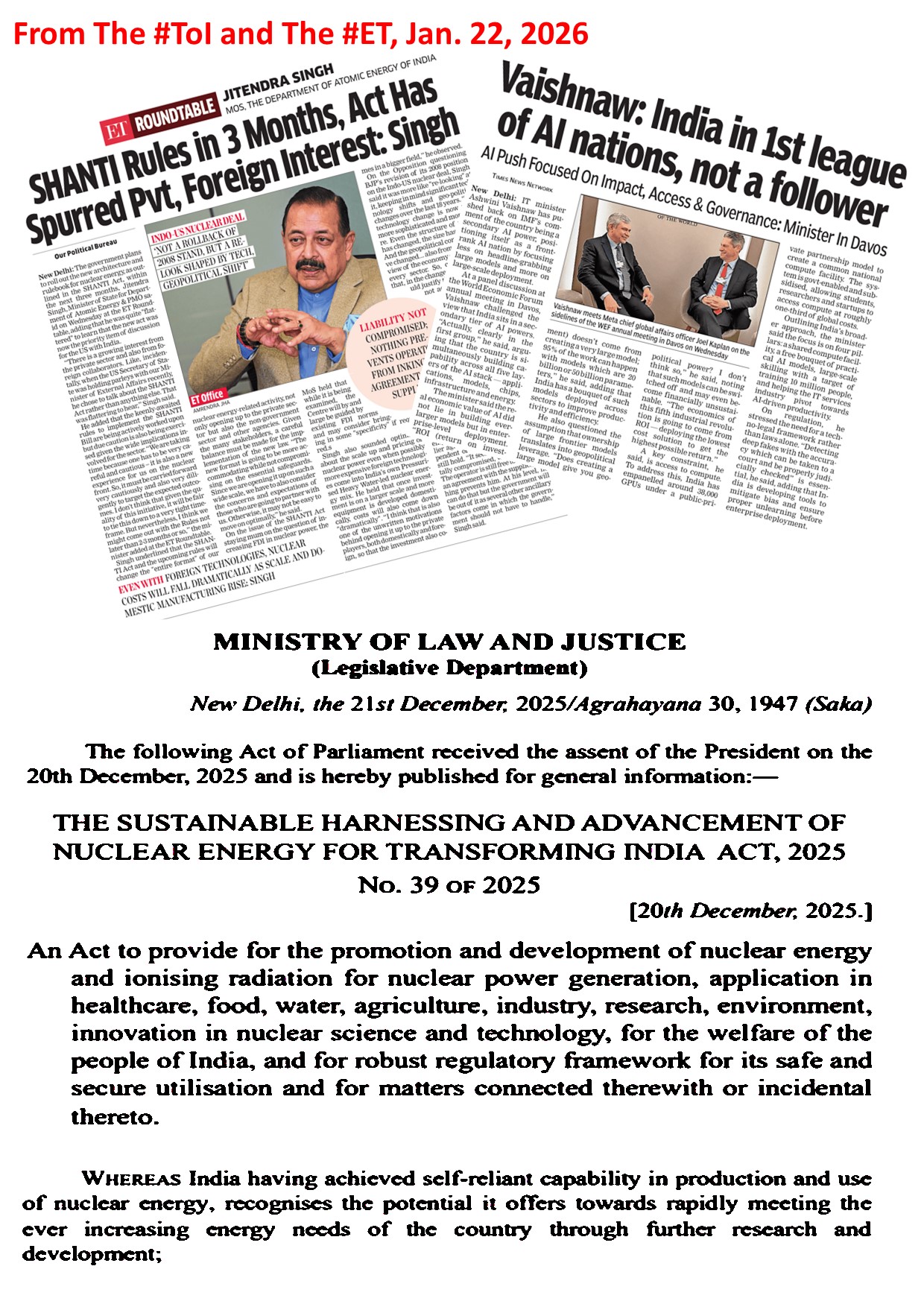
India has framed a comprehensive legislation, Sustainable Harnessing and Advancement of Nuclear Energy for Transforming India Act, 2025, on its nuclear energy programme, a much-needed step to compete with technologically advanced countries. Keeping in view that there is lot of bullying by countries like USA against nuclear programmes of developing countries, it has been made clear in the law that it is for promotion and development of nuclear energy and ionising radiation for peaceful purposes like, power generation, health care, etc. However much more than this is the declaration in the preamble that the goal is to generate energy for development of artificial intelligence and other digital technologies for the benefit of people of India.
The law opens door for participation of private players in harnessing nuclear energy. The law also takes on board India’s ambition of Viksit Bharat (developed India). For this purpose, patent regime has also been opened for promoting innovation in nuclear technology.
Previous two legislations, namely, the Atomic Energy Act, 1962 and the Civil Liability for Nuclear Damage Act, 2010, stand repealed. Now there is only one legislation which comprehensively takes care of India’s nuclear programme.
However, an amusing aspect which we in TheLawyerics noted that that the Act has been framed for promoting artificial intelligence which needs seamless generation of energy for AI services, and the AI would in turn be used for the purpose of regulatory oversight of nuclear energy generation. Thus, interdependence between nuclear energy and AI has been statutorily recognised. Let us hope that this kind of forward-looking programme takes off at the earliest and we stand at par with other countries, and more particularly we are able to convey a clear message to our neighouring country, China that we are not lagging behind.
Despite all these laudable efforts, what we in TheLawyerics still wonder that we are not quite progressive in protecting our data. Though data protection legislation is in place, yet one is yet to see perceptible progress in this direction. The foreign operated social media still rules Indian mind. We do not have our indigenous social media platforms. A few months back, Zoho’s messaging service, Arattai, was warmly applauded by most of Indians but it appears that it is not able to compete with WhatsApp.
India has framed a comprehensive legislation, Sustainable Harnessing and Advancement of Nuclear Energy for Transforming India Act, 2025, on its nuclear energy programme, a much-needed step to compete with technologically advanced countries. Keeping in view that there is lot of bullying by countries like USA against nuclear programmes of developing countries, it has been made clear in the law that it is for promotion and development of nuclear energy and ionising radiation for peaceful purposes like, power generation, health care, etc. However much more than this is the declaration in the preamble that the goal is to generate energy for development of artificial intelligence and other digital technologies for the benefit of people of India.
The law opens door for participation of private players in harnessing nuclear energy. The law also takes on board India’s ambition of Viksit Bharat (developed India). For this purpose, patent regime has also been opened for promoting innovation in nuclear technology.
Previous two legislations, namely, the Atomic Energy Act, 1962 and the Civil Liability for Nuclear Damage Act, 2010, stand repealed. Now there is only one legislation which comprehensively takes care of India’s nuclear programme.
However, an amusing aspect which we in TheLawyerics noted that that the Act has been framed for promoting artificial intelligence which needs seamless generation of energy for AI services, and the AI would in turn be used for the purpose of regulatory oversight of nuclear energy generation. Thus, interdependence between nuclear energy and AI has been statutorily recognised. Let us hope that this kind of forward-looking programme takes off at the earliest and we stand at par with other countries, and more particularly we are able to convey a clear message to our neighouring country, China that we are not lagging behind.
Despite all these laudable efforts, what we in TheLawyerics still wonder that we are not quite progressive in protecting our data. Though data protection legislation is in place, yet one is yet to see perceptible progress in this direction. The foreign operated social media still rules Indian mind. We do not have our indigenous social media platforms. A few months back, Zoho’s messaging service, Arattai, was warmly applauded by most of Indians but it appears that it is not able to compete with WhatsApp.
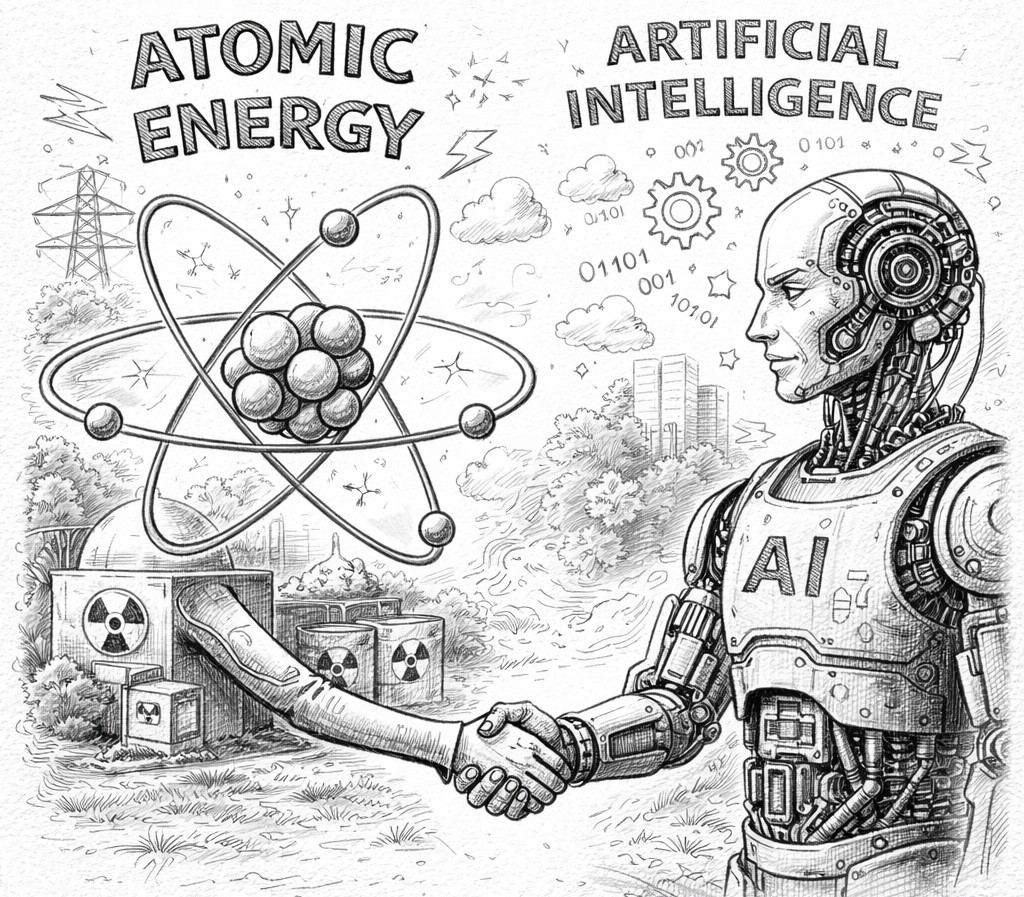
Nuclear energy, AI nexus
We in TheLawyerics encouraged many of our contacts to switch over to Arattai but because of inadequate response, we ourselves are turning back to WhatsApp which is much more developed than Arattai. That is the sign of our digital weakness. Earlier, an Indian message App, Koo, was shut down under similar circumstances.
Are we not subjecting ourselves to digital colonialism? Everyone knows that social media platforms like X, Facebook, etc. have potential to pull down Governments. Political parties win or lose elections according to their social media strategies. The sooner we escape from foreign dominance, the better it is.
Additionally, it is also not clear why India is so slow in regulating AI which is as risky as nuclear technology is. Once India has revealed its policy on nuclear policy through SHANTI Act, it should also take urgent steps in regulating AI and other digital technologies. A comprehensive legislation is needed for all digital technologies. Data protection law, though desirable, is not adequate to control watershed of digital technologies which is not only deeply impacting our life but our psyche also.

TheLawyerics
Click the link below to download PDF
Nuclear energy, AI nexus
Nuclear energy, AI nexus