
Act Before It is Too Late!
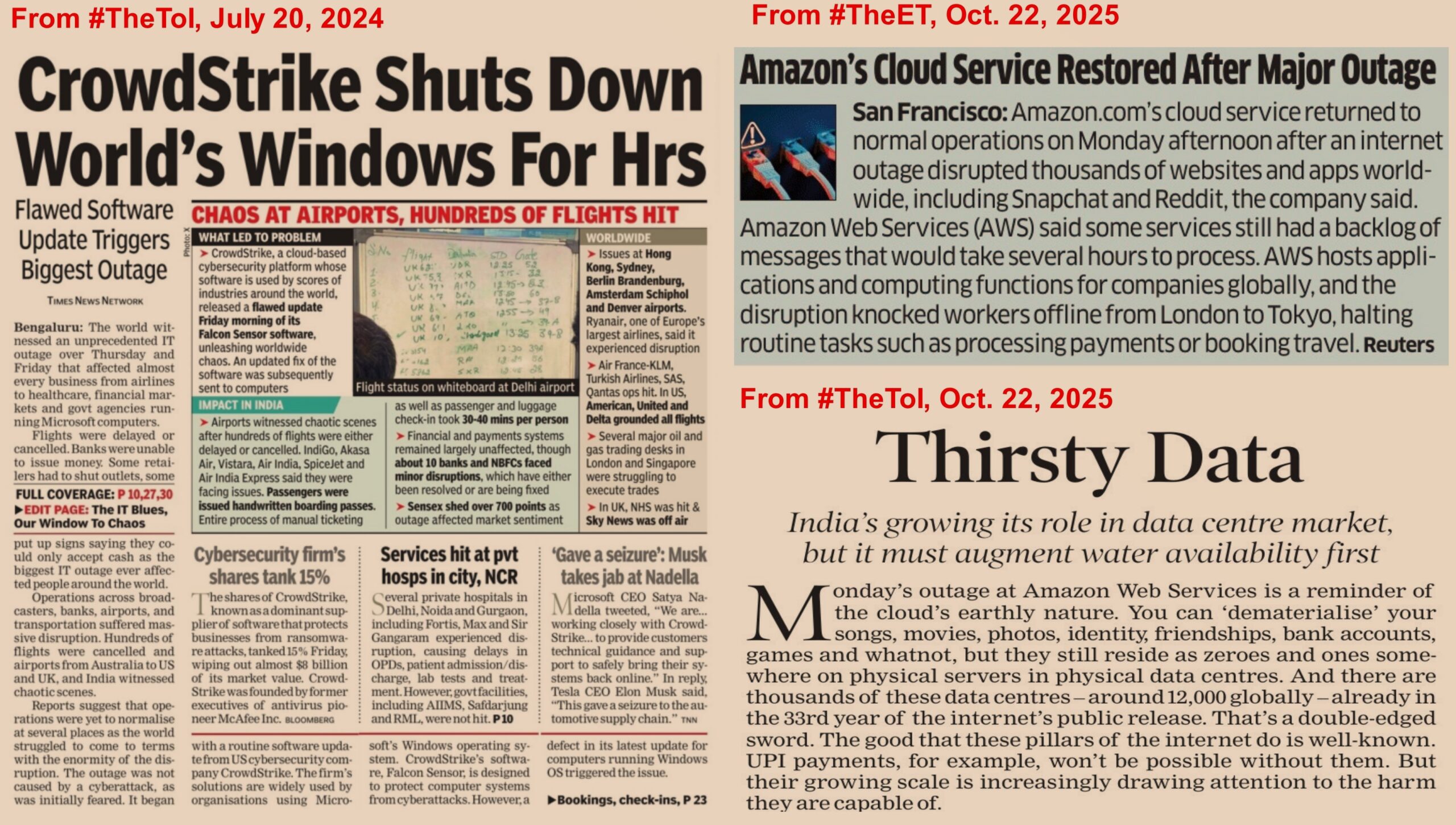
These are the things which give cold shudder to those who are mindful of risks of modern technologies.
On July 19, 2024, there was worldwide outage of the Microsoft services. The reason was security update of CrowdStrike with which Microsoft had tied up for security of its systems. There were chaos all around – at airports, hospitals and elsewhere. India too felt its impact. Even an ordinary person like me was disoriented for some time because it was not immediately clear to me why Microsoft Apps were not working properly. My initial reaction was to blame local internet service provider because I never thought that the services of digital giant like Microsoft are also vulnerable to disruption. It was much later, when the services were partially restored, it became clear from media that mighty Microsoft was down. In India, our Cyber Emergency Response Team (CERT) meekly issued an advisory and thereafter the matter rested forever. Now it is Amazon’s cloud which has recently gone down.
No one takes serious view of such outages, not even our Governments. Perhaps for them, it is a matter between consumers and their service providers. It is an ostrich like approach. It is not that simple. These are utility services which are availed by public at large whether they are provided by private a player or by government agency. As far as my knowledge of law goes, Government has power to regulate them because of their impact on general public. Under the common law, even private parties like keepers of inns and ferry services providers were in olden days obliged to follow regulatory mandates of the Government.
At least one classic case, Rylands v. Fletcher (1868) is before us for guidance. That was a case where action under torts law was brought for overflow of water from defendant’ reservoir to plaintiff’s mines. For that also, the House of Lords, laid down the law as follows, “The person whose grass or corn is eaten down by escaping cattle of his neighbour, or whose mine is flooded by the filth of his neighbour’s privy, or whose habitation is made unhealthy by fumes and noisome vapours of his neighbour’s alkali works, is damnified without any fault of his own; and it seems but reason and just that the neighbour who has brought something on his own property (which was not naturally there), but which he knows will be mischievous if it gets on his neighbour’s, should be obliged to make good the damages which ensues if he does not succeed in confining it to his own property. But for his act in bringing it there no mischief couldhave occurred, and it seems but just that he should at his peril keep it there, so that no mischief may accrue, or answer for the natural and anticipated consequence.”
This was the law laid down for harm coming from simple things like “beasts, or water, or filth, or stenches.”
However, when horrible Bhopal gas leak occurred in 1984 which resulted in many deaths, the Supreme Court of India realisig the enormity of the tragedy, declined to go by milder principle of Rylands v. Fletcher, and laid down its own rules of strict liability for industrial disasters. The Supreme Court in Charan Lal Sahu v. Union of India, (1990) 1 SCC 613 (para 91), modified the law as follows, “If the enterprise is permitted to carry on a hazardous or dangerous activity for its profit, the law must presume that such permission is conditional on the enterprise absorbing the cost of any accident arising on account of such activity as an appropriate item of its overheads. The enterprise alone has the resource to discover and guard against hazardous or dangers and to provide warning against potential hazards. … the measure of compensation in these kinds of cases must be correlated to the magnitude and capacity of the enterprise because such compensation must have a deterrent effect. The larger and more prosperous the enterprise, the greater must be the amount of compensation payable by it for the harm caused on account of an accident in the carrying on of the hazardous or inherently dangerous activity by the enterprise. The determination of actual damages payable would depend upon various facts and circumstances of the particular case.” (emphasis added)
On July 19, 2024, there was worldwide outage of the Microsoft services. The reason was security update of CrowdStrike with which Microsoft had tied up for security of its systems. There were chaos all around – at airports, hospitals and elsewhere. India too felt its impact. Even an ordinary person like me was disoriented for some time because it was not immediately clear to me why Microsoft Apps were not working properly. My initial reaction was to blame local internet service provider because I never thought that the services of digital giant like Microsoft are also vulnerable to disruption. It was much later, when the services were partially restored, it became clear from media that mighty Microsoft was down. In India, our Cyber Emergency Response Team (CERT) meekly issued an advisory and thereafter the matter rested forever. Now it is Amazon’s cloud which has recently gone down.
No one takes serious view of such outages, not even our Governments. Perhaps for them, it is a matter between consumers and their service providers. It is an ostrich like approach. It is not that simple. These are utility services which are availed by public at large whether they are provided by private a player or by government agency. As far as my knowledge of law goes, Government has power to regulate them because of their impact on general public. Under the common law, even private parties like keepers of inns and ferry services providers were in olden days obliged to follow regulatory mandates of the Government.
At least one classic case, Rylands v. Fletcher (1868) is before us for guidance. That was a case where action under torts law was brought for overflow of water from defendant’ reservoir to plaintiff’s mines. For that also, the House of Lords, laid down the law as follows, “The person whose grass or corn is eaten down by escaping cattle of his neighbour, or whose mine is flooded by the filth of his neighbour’s privy, or whose habitation is made unhealthy by fumes and noisome vapours of his neighbour’s alkali works, is damnified without any fault of his own; and it seems but reason and just that the neighbour who has brought something on his own property (which was not naturally there), but which he knows will be mischievous if it gets on his neighbour’s, should be obliged to make good the damages which ensues if he does not succeed in confining it to his own property. But for his act in bringing it there no mischief couldhave occurred, and it seems but just that he should at his peril keep it there, so that no mischief may accrue, or answer for the natural and anticipated consequence.”
This was the law laid down for harm coming from simple things like “beasts, or water, or filth, or stenches.”
However, when horrible Bhopal gas leak occurred in 1984 which resulted in many deaths, the Supreme Court of India realisig the enormity of the tragedy, declined to go by milder principle of Rylands v. Fletcher, and laid down its own rules of strict liability for industrial disasters. The Supreme Court in Charan Lal Sahu v. Union of India, (1990) 1 SCC 613 (para 91), modified the law as follows, “If the enterprise is permitted to carry on a hazardous or dangerous activity for its profit, the law must presume that such permission is conditional on the enterprise absorbing the cost of any accident arising on account of such activity as an appropriate item of its overheads. The enterprise alone has the resource to discover and guard against hazardous or dangers and to provide warning against potential hazards. … the measure of compensation in these kinds of cases must be correlated to the magnitude and capacity of the enterprise because such compensation must have a deterrent effect. The larger and more prosperous the enterprise, the greater must be the amount of compensation payable by it for the harm caused on account of an accident in the carrying on of the hazardous or inherently dangerous activity by the enterprise. The determination of actual damages payable would depend upon various facts and circumstances of the particular case.” (emphasis added)
Building on the experience which our Government in India had from Bhopal gas leak tragedy, it has enacted the Civil Liability for Nuclear Damage Act, 2010, wherein nuclear operator’s civil liability has been fixed but the legislation has at the same time shielded the nuclear operators. A safe harbour has been created for nuclear operator “… where such damage is caused by a nuclear incident directly due to – (i) a grave natural disaster of an exceptional character; (ii) an act of armed conflict, hostility, civil war, insurrection or terrorism. … (3) Where any nuclear damage is suffered by a person on account of his own negligence or from his own acts of commission or omission …” These exceptions considerably dilute nuclear operator’s liability. It is said that the exceptions have been built into law on the insistence of nuclear operators who would be assisting India to produce nuclear energy. They did not want to suffer the kind of damages which were imposed by the Supreme Court of India on Union Carbide in Bhopal gas leak case.
Humanity is making technological progress so that life becomes easy but everything is coming with deadly and more deadly risks.
The question is, when India has sufficient experience of technological mishaps, why it is taking so much time to put in place the laws to take care of all these things.
The impact of digital and electromagnetic technologies is enormous. The functioning of the entire world rests on optical fibers of hairbreadth and electromagnetic waves. Both are fragile and vulnerable. But still the humanity has chosen to rest its future on them. Consider any walk of life, these technologies permeate our life one way or the other.
Those who are familiar with evolution of internet know the reason why internet was developed by USA. When erstwhile USSR put its satellite, Sputnik, in space, USA immediately estimated its potential threat. The Americans became alert that all their civilian and defence installations were under USSR’s surveillance. Their first priority was to back up their communications system through alternative routes so as to minimize the harm. If their one node of communication system was destroyed by Russian attack, they could communicate through web of alternative routes. This gave rise to internet which later on grew into world wide web.
Now that internet and digital technologies have developed considerably, the race is for hoarding as much data as possible. It is needed for AI. The more data you have, the better AI product you may be able to develop. It is for this reason that most of countries are vying for data centres on their land. This in turn is giving rise to more and more energy requirements. AI processing centres too need huge amount of energy apart from sophisticated digital processor chips. It is understood that some digital giants are exploring the possibilities of tying up with nuclear power production plants so that they can get 24 x 7 supply of energy they need to provide uninterrupted services. As noted above, nuclear technology is also risky. In short, we are adding more and more risks to ourselves.
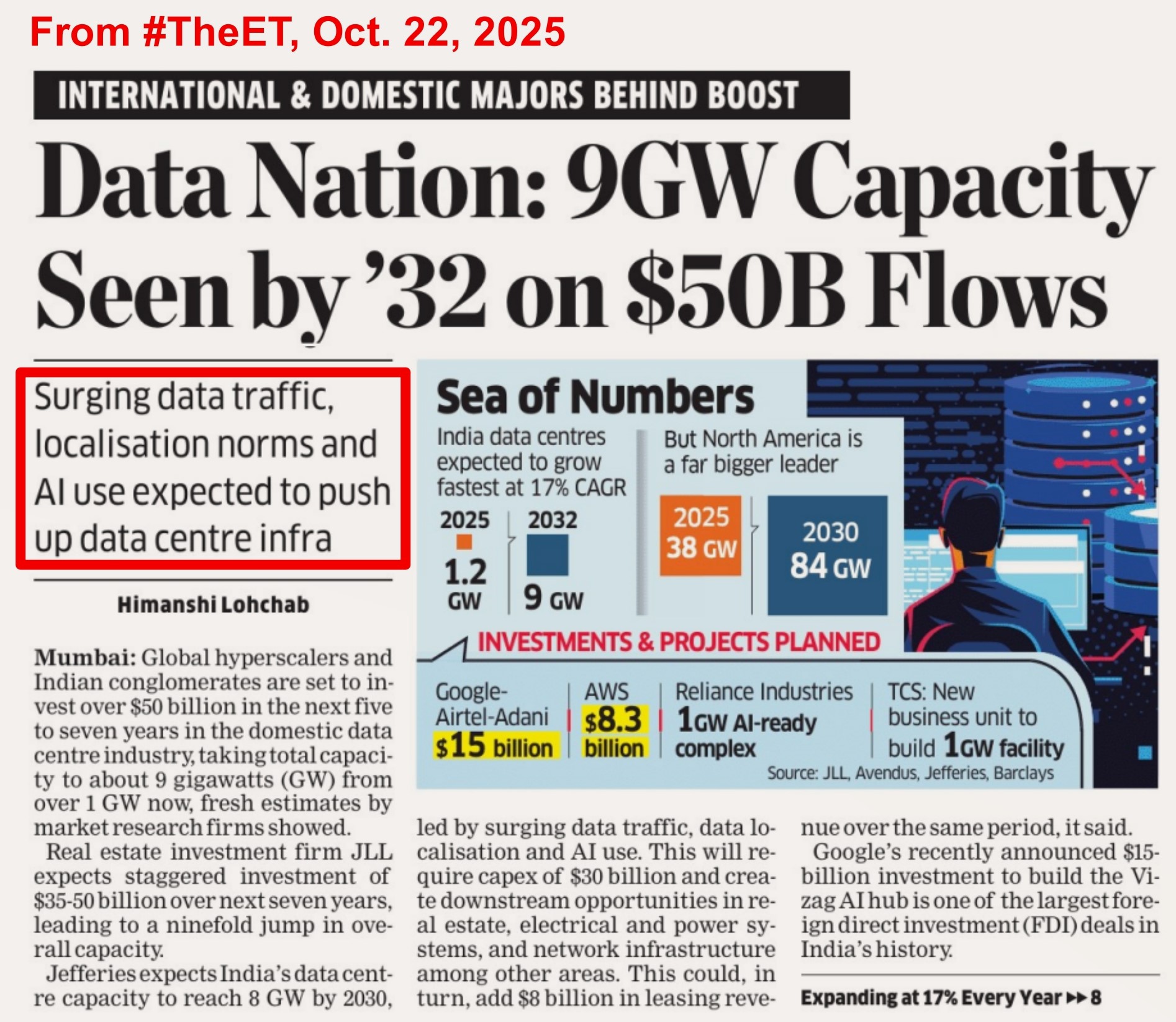 These are the things which the Governments all over the world should ponder and should prepare themselves – risk prevention or at least risk minimisation measures are urgently needed. But it is doubtful that anyone is thinking about it. When we talk of sustainable development, it means we should be alive to risks of modern technologies. It is here, the entire humanity is failing. They may have no answer to give to future generations.
Humanity is making technological progress so that life becomes easy but everything is coming with deadly and more deadly risks.
The question is, when India has sufficient experience of technological mishaps, why it is taking so much time to put in place the laws to take care of all these things.
The impact of digital and electromagnetic technologies is enormous. The functioning of the entire world rests on optical fibers of hairbreadth and electromagnetic waves. Both are fragile and vulnerable. But still the humanity has chosen to rest its future on them. Consider any walk of life, these technologies permeate our life one way or the other.
Those who are familiar with evolution of internet know the reason why internet was developed by USA. When erstwhile USSR put its satellite, Sputnik, in space, USA immediately estimated its potential threat. The Americans became alert that all their civilian and defence installations were under USSR’s surveillance. Their first priority was to back up their communications system through alternative routes so as to minimize the harm. If their one node of communication system was destroyed by Russian attack, they could communicate through web of alternative routes. This gave rise to internet which later on grew into world wide web.
Now that internet and digital technologies have developed considerably, the race is for hoarding as much data as possible. It is needed for AI. The more data you have, the better AI product you may be able to develop. It is for this reason that most of countries are vying for data centres on their land. This in turn is giving rise to more and more energy requirements. AI processing centres too need huge amount of energy apart from sophisticated digital processor chips. It is understood that some digital giants are exploring the possibilities of tying up with nuclear power production plants so that they can get 24 x 7 supply of energy they need to provide uninterrupted services. As noted above, nuclear technology is also risky. In short, we are adding more and more risks to ourselves.
These are the things which the Governments all over the world should ponder and should prepare themselves – risk prevention or at least risk minimisation measures are urgently needed. But it is doubtful that anyone is thinking about it. When we talk of sustainable development, it means we should be alive to risks of modern technologies. It is here, the entire humanity is failing. They may have no answer to give to future generations.Authors’ introduction: Vidya Sagar and Amolak are running the law firm, TheLawyerics, and are practising lawyers of the Supreme Court of India. They generally concentrate in their legal practice on cases relating to technology related laws. They can be reached through e-mail Id., vs.adv[at]outlook[dot]com.
©TheLawyerics. Fair use however excepted subject to acknowledgement of the copyright and incorporation of hyperlink through which this material has been downloaded.
Click the link below to download PDF
Technological Risks and Law
Technological Risks and Law