
Survival is the instinct of every living being. Animals too have it, so do the humans.
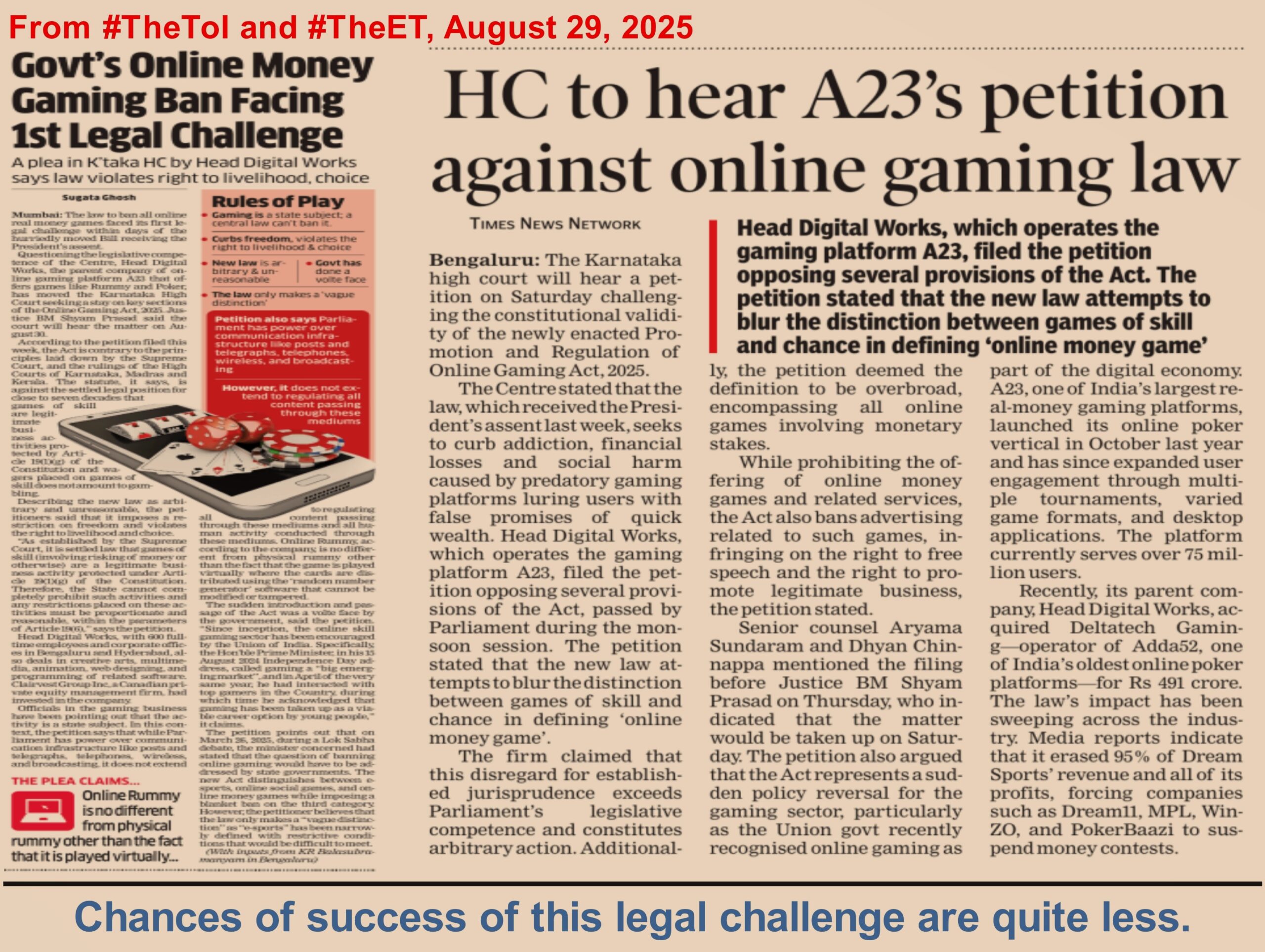
The legal challenge posed to anti-gaming law (The Promotion and Regulation of Online Gaming Act, 2025) must be seen in the background of similar challenge posed some years to real estate law. When real estate law was passed in 2016, there was spate of litigation against it, initially in Bombay High Court and then in Supreme Court. But the law survived the constitutional challenge. Reason was that building projects became big rackets. People lost their hard-earned money. A public welfare legislation had to be passed to protect home buyers. So is the case with anti-gaming law. Legislation has tried to balance the competing interests but at the same time to target illegal and immoral activity.
This is one of the laws where a fairly elaborate long title and twelve recitals have been inserted into the Act to explain the purpose of legislation. The name of the Act itself suggests that legislature wants to promote online ethical gaming but in a regulated way. There is sufficient guidance for the court to interpret and implement the law. Regulatory machinery has been created to regulate online gaming.
The third and fourth recital in the Act recongises economic worth of the ethical gaming, and its potential to generate employment and its contribution to national economy. But at the same time, eighth and ninth recital highlights the dangers of unethical gaming. “… the unchecked expansion of online money gaming services has been linked to unlawful activities including financial fraud, money laundering, tax evasion, and in some cases, the financing of terrorism, thereby posing threats to national security, public order and the integrity of the State.” “… considering the deleterious and negative impact on online money games on the individuals, families, society and the nation and given the technical aspects including the very nature of the electronic medium used for online money games, the algorithm applied and the national and transnational networks involved therein”
The sixth recital specifically highlights unethical use of AI through manipulated algorithms. “… such games often use manipulative design features, addictive algorithms, bots and undisclosed agents, undermining fairness, transparency and user protection, while promoting compulsive behaviour leading to financial ruin”
The legal challenge posed to anti-gaming law (The Promotion and Regulation of Online Gaming Act, 2025) must be seen in the background of similar challenge posed some years to real estate law. When real estate law was passed in 2016, there was spate of litigation against it, initially in Bombay High Court and then in Supreme Court. But the law survived the constitutional challenge. Reason was that building projects became big rackets. People lost their hard-earned money. A public welfare legislation had to be passed to protect home buyers. So is the case with anti-gaming law. Legislation has tried to balance the competing interests but at the same time to target illegal and immoral activity.
This is one of the laws where a fairly elaborate long title and twelve recitals have been inserted into the Act to explain the purpose of legislation. The name of the Act itself suggests that legislature wants to promote online ethical gaming but in a regulated way. There is sufficient guidance for the court to interpret and implement the law. Regulatory machinery has been created to regulate online gaming.
The third and fourth recital in the Act recongises economic worth of the ethical gaming, and its potential to generate employment and its contribution to national economy. But at the same time, eighth and ninth recital highlights the dangers of unethical gaming. “… the unchecked expansion of online money gaming services has been linked to unlawful activities including financial fraud, money laundering, tax evasion, and in some cases, the financing of terrorism, thereby posing threats to national security, public order and the integrity of the State.” “… considering the deleterious and negative impact on online money games on the individuals, families, society and the nation and given the technical aspects including the very nature of the electronic medium used for online money games, the algorithm applied and the national and transnational networks involved therein”
The sixth recital specifically highlights unethical use of AI through manipulated algorithms. “… such games often use manipulative design features, addictive algorithms, bots and undisclosed agents, undermining fairness, transparency and user protection, while promoting compulsive behaviour leading to financial ruin”
The seventh recital highlights how “youth and vulnerable groups” become victims through aggressive promotion of some online gaming activities which are unethical.
The Act separately defines “online game” and “online money game”. It is online money game which has been targeted for prohibition. “No person shall offer, aid, abet, induce or otherwise indulge or engage in the offering online money game and online money gaming service.”
Coming now to the specific issue whether game of skill has also been outlawed, perhaps it is not. The long title of the Act recognises e-sports and educational games. First recital also recognises the role of online activity in “cognitive development”. The e-sports activities receive further pat by conferring power on the Central Government “to recognise and register e-sports”.
Prima facie the Act is a wholesome legislation. It takes care of all relevant factors. It is uncomfortable only to those who have gone outside the limits fairness.
There is saying in our country, “जुआ किसी का न हुआ”. It is a bitter reality. All of us know the outcome of PUBG. Some decades ago, there were lottery stalls and even lottery markets in every locality in India. People became habitual to easy money through hope that they would win lottery. They used to throng lottery stalls with this false hope but the outcome was that they used to lose whatever little they had. It had to be stopped. Indian wisdom tells us to earn our livelihood by dint of our hard work. This bring contentment. We learn to live within our means. Short cuts to earn money quickly prove disastrous. Online gaming is loaded with predefined algorithms. They are meant to help service provider, not the player. In this materialist word, nobody gives anything free. It is a myth. There is an Indian song, “गरज़परस्त जहाँ में वफ़ा तलाश न कर, ये शै बनी थी किसी दूसरे जहाँ के लिए”
Please do not bang your head unnecessarily against anti-gaming legislation by finding faults in it. It is a good legislation, let us accept it. Let us watch its working for some time and then see whether it requires any improvement.
The Act separately defines “online game” and “online money game”. It is online money game which has been targeted for prohibition. “No person shall offer, aid, abet, induce or otherwise indulge or engage in the offering online money game and online money gaming service.”
Coming now to the specific issue whether game of skill has also been outlawed, perhaps it is not. The long title of the Act recognises e-sports and educational games. First recital also recognises the role of online activity in “cognitive development”. The e-sports activities receive further pat by conferring power on the Central Government “to recognise and register e-sports”.
Prima facie the Act is a wholesome legislation. It takes care of all relevant factors. It is uncomfortable only to those who have gone outside the limits fairness.
There is saying in our country, “जुआ किसी का न हुआ”. It is a bitter reality. All of us know the outcome of PUBG. Some decades ago, there were lottery stalls and even lottery markets in every locality in India. People became habitual to easy money through hope that they would win lottery. They used to throng lottery stalls with this false hope but the outcome was that they used to lose whatever little they had. It had to be stopped. Indian wisdom tells us to earn our livelihood by dint of our hard work. This bring contentment. We learn to live within our means. Short cuts to earn money quickly prove disastrous. Online gaming is loaded with predefined algorithms. They are meant to help service provider, not the player. In this materialist word, nobody gives anything free. It is a myth. There is an Indian song, “गरज़परस्त जहाँ में वफ़ा तलाश न कर, ये शै बनी थी किसी दूसरे जहाँ के लिए”
Please do not bang your head unnecessarily against anti-gaming legislation by finding faults in it. It is a good legislation, let us accept it. Let us watch its working for some time and then see whether it requires any improvement.
Online gaming – Post by TheLawyerics
Click the link below to download PDF
Online gaming
Online gaming